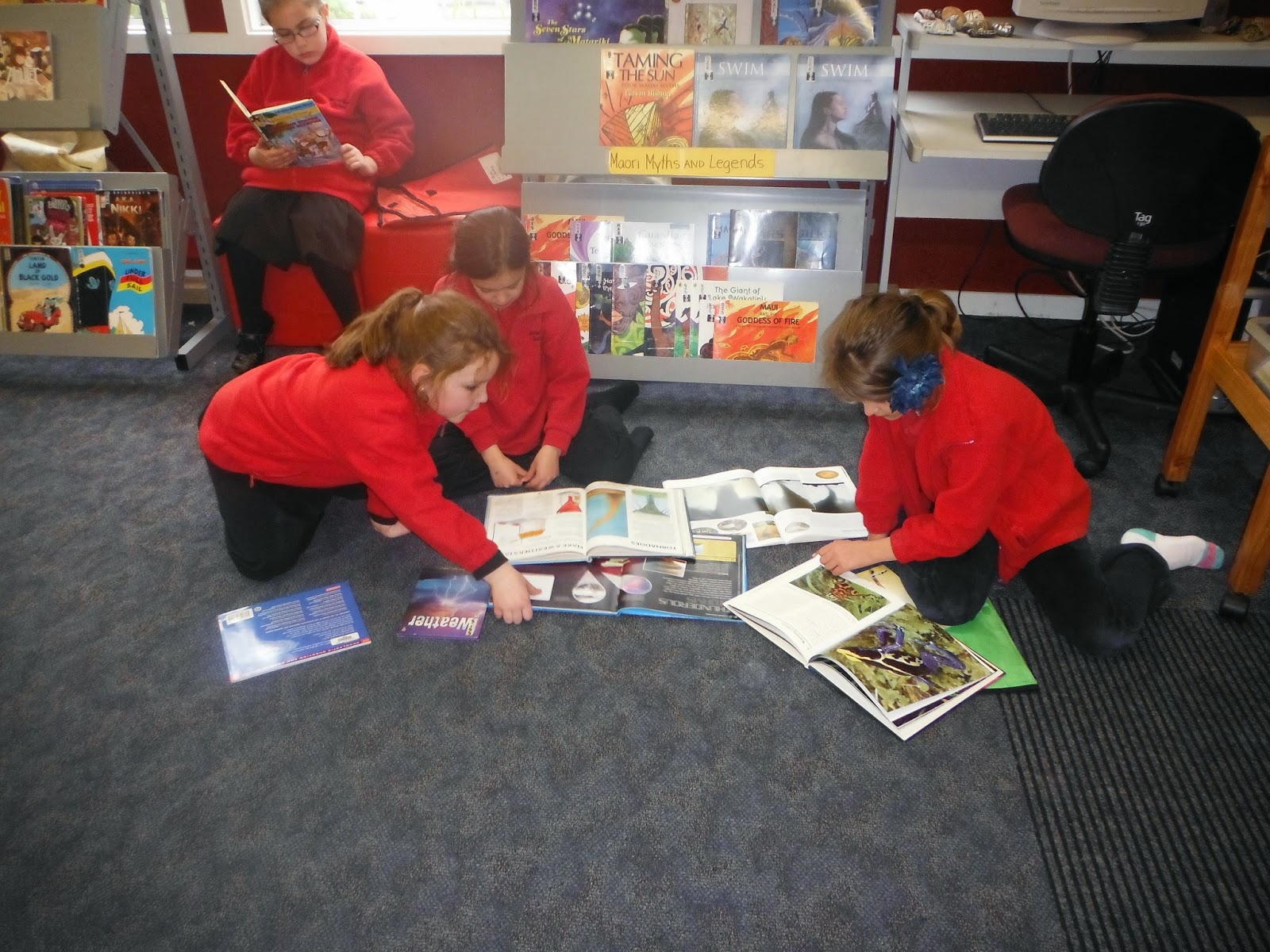
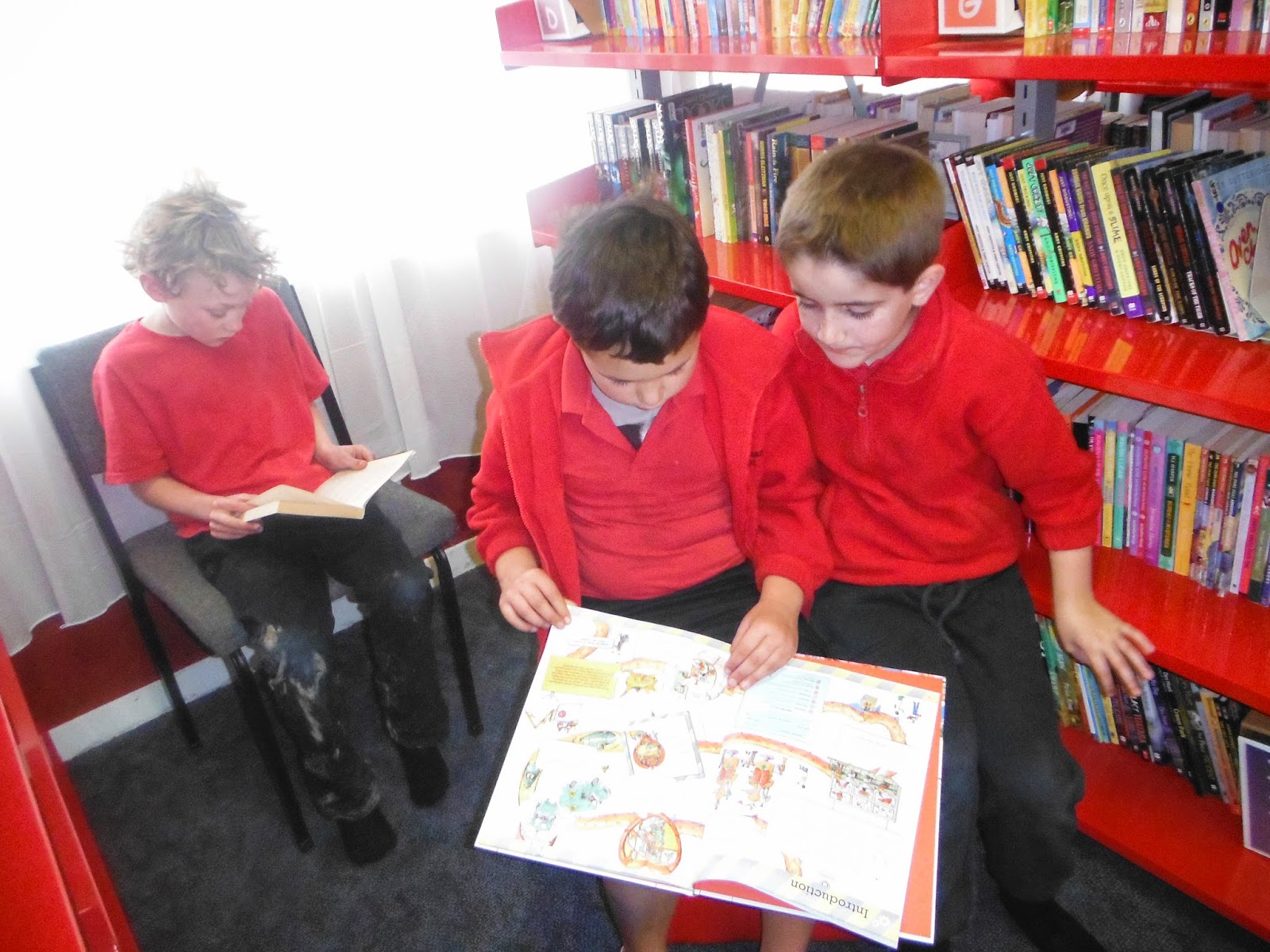
What is the best way to hear a story? Make a nest out of cushions and get your older sister to read to you. Lovely
Pages
- Home
- About Us
- Authors
- Book Trailers
- Gallery
- Literacy Games
- Math Games
- Parents/Whanau
- Popular Picture Books
- Popular Junior Fiction
- Popular Older Fiction
- Popular Senior Fiction
- Research Links
- Cultural Diversity
- E.S.O.L
- Maori Language
- N.Z. Sign Language
- Old Library Alive
- Old Library Tour
- Order in the Library
Showing posts with label Reading. Show all posts
Thursday, 26 July 2018
Tuesday, 5 April 2016
Books by Dr. Seuss
“If you never did you should.
These things are fun and fun is good”
~ Dr.
Seuss
One sunny day, while swimming in a pool, my husband and I overheard a
lady proclaiming to the world that Dr. Seuss’ books were absurd and should not
be read to children. Her reason: incorrect use of the English language. Oh
lady, you’ve really missed the whole point, haven’t you?! Here are five reasons
you should love Dr. Seuss, including his absurdity:
1. Great for Beginning Readers and Mastering
Phonics
A child who is learning to read is learning to connect the sounds that
go with letters so that he can then put them together to make words … which
then become sentences. Repeating sounds frequently, help a child master this
skill. Dr. Seuss is the master of repetitive sounds and engaging stories, while
using limited vocabulary—an ideal combination for a beginning reader. A good
example: Hop on Pop.
2. Great Read-Aloud Books
Thanks to his clever rhyming, Dr. Seuss’ books sound great when
they are read aloud. Did you know that reading to an infant helps with brain
development, speech skills, and bonding between parent and child? There are a
lot of Dr. Seuss books available in board book format (Bright and Early, Board
Books), which are the perfect size and durability for little hands and curious
mouths. Example: Put me in the Zoo
3. Great for Reluctant Readers
Sometimes the hardest part of reading is getting your child to read. I
think you would be hard pressed to find a child that would not be entertained
by the sheer absurdity of Dr. Seuss’s wacky plots and zany characters. Example: I Wish that I Had Duck Feet. Sometimes a
little fun and excitement is all that is needed to get kids reading.
4. Great for Teaching Life’s Lessons
With enchanting worlds and wonderful creatures, both familiar and
unfamiliar, Dr. Seuss teaches readers many admirable life lessons.
Example: The Lorax is a great
book for teaching children the importance of taking responsibility for the
earth.
Tuesday, 23 February 2016
Reading Aloud - Tips
Here is a great link about "Tips on reading aloud"

Tuesday, 26 May 2015
Love to Read around the world
Click on link below and see what is the most popular book to read in each country by clicking on the book icon
Sunday, 3 May 2015
Judy Blume
"Parents worry much too much about what their children are reading" - Judy Blume
Parents worry "much too much" about what their children are reading, said the author Judy Blume. She argued that they will simply "self-censor" by getting bored of anything they do not understand.
Blume, the bestselling author of Forever, Blubber and Are You There God? It's Me, Margaret, said people should not be unduly concerned about their children's reading material.
If the content was unsuitable, she argued, children would simply tire of it or let it wash over their heads without understanding.
Speaking at the Hay Festival, she said the experience of having her own books banned in the Eighties was "alarming", leaving her feeling "very alone".
Her novels, which confront issues of teenage sex, racism, divorce, bullying, puberty and masturbation, were considered shocking at the time, and are remembered by a generation of women for teaching them the facts of life.
Blume, now 76, has sold more than 80 million books worldwide and her work has been translated into 31 languages.
She told the audience that parents should be less concerned about the suitability of their children's reading material, concentrating more on simply getting them to love books.
"A lot of people worry much too much about what their children are reading," she said.
"A lot of people will want to control everything in their children's lives, or everything in other people's children's lives.
"If a child picks up a book and reads something she has a question about, if she can go to her parents, great.
"Or else they will read right over it. It won't mean a thing.
"They are very good, I think, at monitoring what makes them feel uncomfortable. If something makes them feel uncomfortable they will put it down."
Some of Blume's own books, written and published in the Seventies, were banned in the United States during the Eighties, with Deenie becoming her "most banned book" for references to the main character's "special place".
"Most of the time they hadn't even read the book," Blume said of the complainants. "Even if they had, they only read what I would call the 'good stuff'.
"It was definitely alarming. It was a very scary time and I felt very alone."
Speaking to her young fans in the audience, she added: "I say go and read. Read what you like to read."
Wednesday, 29 April 2015
Reading in the Library at lunchtime.
Sharing your book with others or reading alone, it is all great and happening in our library.
The Minecraft books always attract a group of enthusiasts.
Thursday, 19 March 2015
Benefits of Reading
Interesting article found in a U.K. magazine
BOOK SMART; THE UNEXPECTED HEALTH BENEFITS OF BEING AN AVID READER
IT REDUCES STRESS
IT REFINES BRAIN FUNCTION
IT HELPS YOUR MEMORY
IT ENHANCES MENTAL AGILITY IN OLD AGE
HEALTH BENEFITS; THE DIFFERENCES BETWEEN ACTUAL BOOKS AND EBOOKS
Click on the link below to read the complete article.
http://www.stylist.co.uk/books/unexpected-health-benefits-of-reading-fiction-books-reading-survey-stress-brain-agility
Sunday, 14 September 2014
Thursday, 14 August 2014
Students in the library this week
Room 5 came to visit and displayed amazing sharing of information through reading
Room 1 came to visit the library and I learnt about Polar bears from Joshua and Layla. Both these students had written down wonderful facts on Polar bears and shared their information with me and their class. They did an amazing job and are only in Year One, imagine what their writings will be like next year
Joshua told me that Polar bears are born blind and deaf, they eat seals and fish and swim in icy water
Layla also told me they are one of the biggest bears and although they look cuddly they are very dangerous.
Then.....
Students from various Yr 5/6 classes visited us for a quiet reading time on Friday afternoon with Mel Styche.
Monday, 11 August 2014
Room 7 enjoying the library
Room 7 had an awesome time in the library today with their teacher Paulette. They listened to a reading of
"Pete the Cat - I love My White Shoes" by Eric Litwin (new book)
they sung along with the song and were happily engaged with reading and sharing their books.
Friday, 10 January 2014
Reading boosts brain function
Brain function 'boosted for days after reading a novel'
Reading a gripping novel causes biological changes in the brain which last for days as the mind is transported into the body of the protagonist
Being pulled into the world of a gripping novel can trigger actual, measurable changes in the brain that linger for at least five days after reading, scientists have said.
The new research, carried out at Emory University in the US, found that reading a good book may cause heightened connectivity in the brain and neurological changes that persist in a similar way to muscle memory.
The changes were registered in the left temporal cortex, an area of the brain associated with receptivity for language, as well as the the primary sensory motor region of the brain.
Neurons of this region have been associated with tricking the mind into thinking it is doing something it is not, a phenomenon known as grounded cognition - for example, just thinking about running, can activate the neurons associated with the physical act of running.
“The neural changes that we found associated with physical sensation and movement systems suggest that reading a novel can transport you into the body of the protagonist,” said neuroscientist Professor Gregory Berns, lead author of the study.
“We already knew that good stories can put you in someone else’s shoes in a figurative sense. Now we’re seeing that something may also be happening biologically.”
21 students took part in the study, with all participants reading the same book - Pompeii, a 2003 thriller by Robert Harris, which was chosen for its page turning plot.
“The story follows a protagonist, who is outside the city of Pompeii and notices steam and strange things happening around the volcano,” said Prof Berns. “It depicts true events in a fictional and dramatic way. It was important to us that the book had a strong narrative line.”
Over 19 days the students read a portion of the book in the evening then had fMRI scans the following morning. Once the book was finished, their brains were scanned for five days after.
The neurological changes were found to have continued for all the five days after finishing, proving that the impact was not just an immediate reaction but has a lasting influence.
“Even though the participants were not actually reading the novel while they were in the scanner, they retained this heightened connectivity,” added Prof Berns. “We call that a ‘shadow activity,’ almost like a muscle memory.”
Thursday, 21 November 2013
Christchurch City Libraries Summertime Reading Club
Summertime Reading Club –
Korero pukapuka ā te wā o Raumati
How the Summertime Reading Club works
Read six books of your choice between 20th December 2013 and 24th January 2014, then take your map back into the library to receive your sticker and a $5 Paper Plus voucher. The librarian will also enter you online for the major prize draw of an iPad mini. Please note one entry per child.
For a further challenge, complete the Science Alive reading adventure by reading four different books and spotting the science feature in each of those books. Take the map back into the library and the librarian will enter you into the draw for some more great prizes. Find out more in our FAQ.
Terms and conditions
- You must between 5 and 12 years of age.
- You must be a member of Christchurch City Libraries (membership is free).
- You can begin your challenges from 5pm Friday 24 December 2013. The competition finishes at 5pm Friday 24 January 2014.
- You must read six books.
- The Science Alive Reading Adventure is an extra for those wanting more of a reading challenge.
- You will receive an entry into the prize draw when you take your completed map into the library.
- One entry per child.
- Prize winners will be notified as soon after the closing date as practicable.
- The Summertime Reading Club prize giving will be on 31 January 2014 at 3:30pm. The venue is yet to be confirmed.
- Christchurch City Libraries reserve the right to use the names and suburbs of the winners for promotional purposes.
Monday, 11 November 2013
YES to reading
JOHN HAWKINS/Fairfax NZ
CUT ABOVE THE REST: James Hargest College student Kaela Harley has received the top score for the ICAS English exam.
Invercargill girl (11 year old) who reads at least seven books a week has won an international English competition.
James Hargest College student Kaela Harley has received the highest score for her age group in New Zealand, Australia and the Pacific islands in the International Competitions and Assessments for Schools English exam.
It was the first time she had entered in the competition. "I was really surprised and shocked.
"It was reasonably easy for me, English comes naturally to me," she said.
Kaela said she read about seven books in an average school week and more during school holidays.
"I just love reading. I usually just fit it in when I can."
Earlier this year she participated in a 20-hour famine without books instead of food.
When asked how she coped, Kaela said it was "all right, luckily sleeping counted so that helped".
She ruled out doing the full 40-hour famine without books next year. "No way - I'm not sure I'll make it," she said.
Looking to the future, Kaela said she had hopes of being a teacher or nurse but admitted she had thought about being a librarian.
Teacher Hinea Ruaporo said Kaela had recommended books to her that were now being studied in class. "She reads a phenomenal amount of books each week.
"She's a lover of literacy and her reading.
"Every day's a new book and they're not easy reading," she said.
Kaela will receive her medal of achievement at the University of Auckland Business School on December 7.
The school will hold a bake sale to help raise funds on November 29.
Wednesday, 4 September 2013
Sunday, 16 June 2013
Read to your Kids
"Read to your kids, and you'll transform their lives." David Hill
Author David Hill speaks to the Herald
Monday, 26 November 2012
Reading Strategies
Good Reading Strategies 2009
"This youtube clip shows Students using the 'good reading strategies' they have learnt. This is a video that parents and students will enjoy. These are strategies we learn either from our parents or at school from our teachers, they are very useful and add to the enjoyment of reading." Mrs Chin
Subscribe to:
Posts (Atom)